

One of the strangest things for me, in my years of meandering through various futurist-type communities, is the relative absence of a holistic accounting — epistemological, maybe ontological, though I'd stop short of calling it a failure of rigor — for what actually didn’t work in the past.
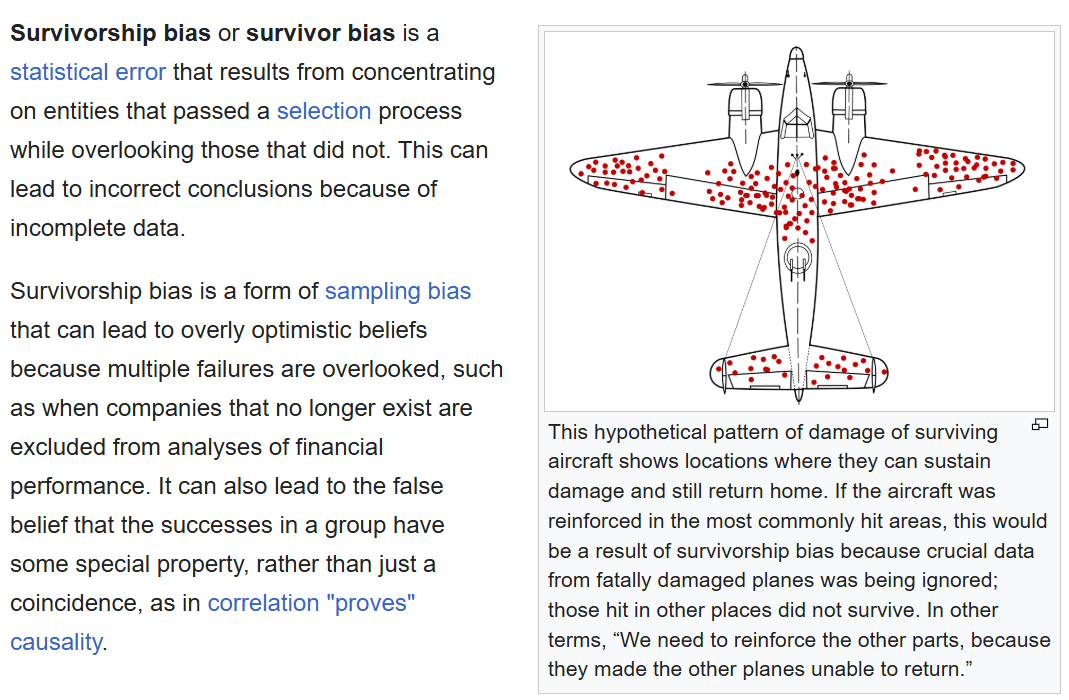
We are good, in these spaces, at studying what survived. We are good at the visions that kept their audiences and the projects that kept their funding, and at reading off their features as if they were a recipe. We are much worse, perhaps curiously worse, at the other half of the ledger: the things that were tried and went nowhere, and the specific reasons they went nowhere.
I’ve come to think that’s backwards, or at least substantially incomplete. In an information-incomplete situation, which is what we’re dealing with as we navigate towards the future, we tend to know what doesn’t work with far more confidence than we know what will. The failures are the more reliable data, and sometimes the only data. We just don’t keep them.
This piece is an attempt to describe that absence precisely enough to be useful. It is not an attempt to fill it. I’ll say what I think is missing, why I think it’s missing, and why I’ve come to believe it’s a load-bearing problem rather than a gap that will close on its own as other work matures. Think of it as a GitHub issue filed against a system still being built, by someone who expects to spend a while working on it.
The Charitable View of this problem space
I spend this section reframing the broader problem somewhat tediously with an attempt to justify why “the way things are” became that way, and the validity or at least reasonable-ness of it. I do this to perform a kind of due diligence before presenting my suggestion for other approaches.
Sympathetically,1 I feel that we are collectively rather underprepared in our means to have the conversation (at scale) in the way I’m suggesting it is possible to do. A large part of why it goes missing is that future-adjacent talk is usually accessed through some other space: a major cause (technology, justice, environmentalism, economics), a particular population or demographic use case, or what I tend to file under "silver bullets." You could call it solutioneering, or the old line about how everything looks like a nail once you're holding a hammer, but neither quite captures the thing I mean, which is that the space is rarely prepared to soberly and substantially discuss what's actually at hand.
Instead there's a defensiveness, and it has recognizable forms: "clearly The Answer to The Problem," or "if we're not centering this, I don't want to even talk to you,"2 or the strongest version, that some overwhelming force will unalterably shape the future, so The Solution must inevitably address it. The defensiveness makes sense once you notice that the frame in question is usually also the community's social glue, so questioning the frame reads as questioning the room.
A rough and ready example. During my days as an energy & technology analyst, a particular community — technologically aware and worldly in scope — centered unalterably on the premise that population growth would drive continuously increasing energy demand, forever. Every solution (vetted to be) discussed took that premise as the price of being taken seriously. Now I’m not saying that is wrong, I just feel that we don’t yet have adequate preparation or literacy3 for how to diagnose that at large.
Here I want to be careful, because there’s substance at hand. The want (and perhaps need) for some sort of certainty in the future is not to be denigrated as a silly, fragile mammalian brain aspiring towards the image of certainty in the future because it offers a sense of security, or a blanket to hide under during the scariness of the present.
Rather, I think there is a charitable and reasonable stance that, at the very least, pointing theoretically at something, imagining a future or set of futures, we need to juxtapose ourselves to “it”, or to “something.” That is a core need, for navigation in general, or for discerning a problem space, or for trying to understand trajectories and paths ahead, particularly in information-incomplete situations like the moment and world and life we are all in, right now.
So the communities I’m gesturing at aren’t being foolish. They’re doing something navigation genuinely requires: fixing a reference to steer by. The trouble is that we’ve built almost all of our references on one side of the ledger.
If you’d like another pass at me trying to contextualize what I mean, I have made an Appendix.
Focusing on the bullet holes of the planes that returned to base,
and not on what was game-over for the planes that did not return
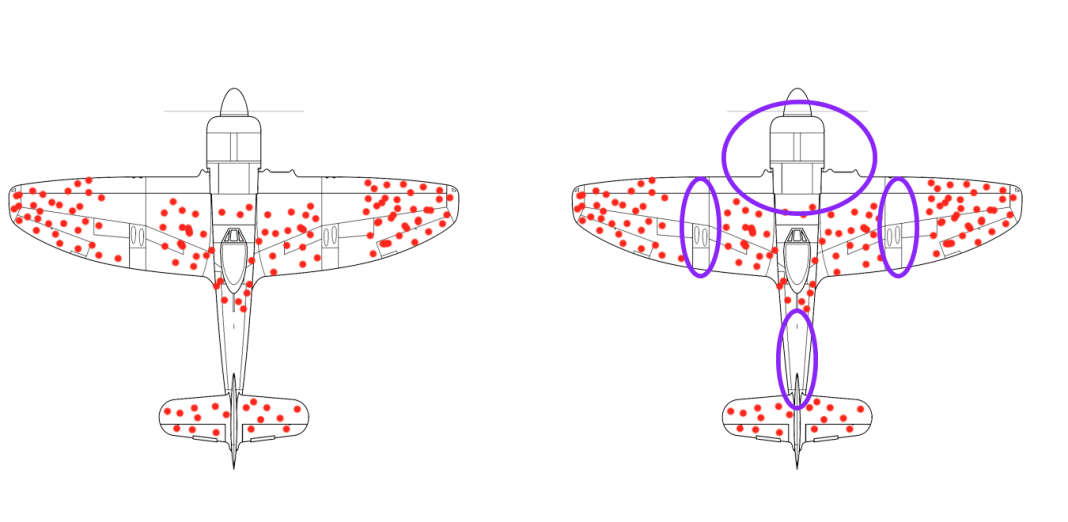
During the Second World War, analysts studying bombers that came back from missions mapped where the returning planes had been hit, and the intuitive recommendation was to reinforce those areas. The insight usually credited to the statistician Abraham Wald4 ran the other way: reinforce the places where the returning planes were not hit. The planes hit in those places were the ones that never came back. The damage map of the survivors was a map of survivable damage. The fatal data was missing precisely because it was fatal.
That’s survivorship bias, and once you’ve seen it, a lot of futurist discourse starts to look like a hangar full of returned planes. We study the visions that made it home and read their features as the recipe, while the projects and framings that went down, and the specific hits that took them down, mostly go unexamined.
But the useful half of Wald’s finding is the part that usually gets left out of the retelling. He wasn’t only saying don’t get hit there. He was saying that the existing model of what made a plane survivable was wrong, because it had been assembled entirely from survivors. The missing planes didn’t just add a warning to the existing picture. They corrected it. And everyone in these communities is carrying a picture, admitted or not.
What I think is actually missing
It would be easy to state this as one large absence and leave it there, which is roughly I’ve done in many informal conversations in the past. So let me try to be more specific. I think there are three missing things, and they’re related but not the same.
We have no shared vocabulary for negative destinations. We can talk at length about futures worth wanting. We have much less language for the outcomes that, if they showed up in the result, would mean we’d failed regardless of what else we achieved. Not risks, which we discuss constantly and quantitatively, but something closer to contaminants — things whose presence spoils the outcome more or less independently of intent. The word matters to me because contamination is a property of the result rather than a judgment of the actor, and that distinction is what keeps this from collapsing into a purity test.
We have no agreed reads for detecting drift. Most contaminants don’t announce themselves at the moment of arrival; they announce themselves on the way, in tells that are legible well before anything is final. Which means the practical question is rarely “have we arrived at a bad end” and almost always “are we getting closer to one.” That’s a directional question, and directional questions need reads — litmus tests, canaries, the specific things you’d look for if you wanted to know whether a project or a community was drifting. We have a few of these informally. We do not have them written down anywhere in common.
We have no practice of maintaining either. Even where individuals hold both, there’s no shared artifact, no upkeep, no convention that says a serious project in this space should be able to state what would count as its own failure. Post-mortems happen. They’re private, scattered, and rarely read across projects. Even less so, robust or sincere efforts to make them interfaceable, particularly across communities of interest or practice
The third is the one that makes this a structural problem rather than a personal one. Vocabulary and reads that live in individual heads don’t compound.
Direction, not just destination
The framing that has made this tractable for me is the broadening from destinations to direction. So what do we have to navigate by? Let’s use terms like landmarks, destinations, and direction here.
If you only consider terminal states — places you must not end up, dead ends, destinations with no “life” or potential in them — then a catalog of them is a fence. Fences are useful and limited. They tell you where not to go and nothing about where to head, and a community that spends its energy building fences tends to end up with a lot of fence and not much else. They have a proxemic and immediate use of setting bounds. But the time element and vector navigation aspects may be lacking.
Even so, is that actually useful for the kind of navigation I’m suggesting we need to develop? These landmarks are rarely a place you arrive at; the world will keep turning either way. Yet seeing the conditions, there are states or configurations we may drift toward, and the drift is detectable long before the arrival. Which means the more ideal catalogue isn’t a fence, rather more like a set of bearings. The useful question it answers is not “is this forbidden” but “which way are we currently moving, and is that toward or away.”
That distinction is one I’m hoping to expand upon; doing it right will be important for substance to follow. A bearing gives you continuous information; a fence only tells you something at the moment you hit it. If you can tell that a project is drifting toward a known contaminant, you have real navigational information in hand — arguably better information than a positive vision provides, because the tells are visible from where you’re standing and the destination usually isn’t (See Appendix B).
This is also the short answer to the objection I expect and think is fair: isn’t this just via negativa, with extra steps? No, or at least not necessarily. There’s an old idea in cybernetics that purposeful behavior is behavior governed by negative feedback relative to a goal — you act, you measure the gap between where you are and where you’re aimed, you correct; so modern day reinforcement learning, in essence. What I’m describing has that same shape, with the sign flipped. You measure the gap between where you are and where you must not end up, and correct away. The correction is as real either way; towards offering more steering, rather than abstention.
I don’t think this makes the negative sufficient on its own. You still have to be building something; a set of bearings with nothing to build is just a well-organized complaint, and I’ll come back to that in the closing. But it does mean a catalog of contaminants and their tells would be an instrument rather than a warning label, which may be more defensible.
What would go into it
I want to be careful here, because I don’t have the catalog and this piece isn’t the place I shall produce one.5 But I can say what I think it would have to account for, which is a more honest kind of specification than a sketch.
The obvious failures. The recent history of future-oriented communities has supplied, at real human cost, several candidates that were visible before they were fatal — the collapse of FTX and what preceded it inside the movement most attached to it; the accounts that have emerged from women in and around AI-adjacent circles; the funding relationships that were rationalized by the importance of the work being funded; institutions devoted to humanity’s long-term future that proved unable to sustain the near-term conditions of their own existence. I’m treating these as a list of instances rather than a set of cases here, because each deserves more care than a clause, and I intend to give them that separately.6 What matters for the specification is that in each one, a community’s commitment to its objective made an obvious contaminant unsayable from the inside. That’s a repeating structure, not a series of unrelated scandals, and any usable catalog would have to encode it.
The people already doing pieces of this. The closest thing I’ve seen to the specification above is coming out of the MIT Media Lab’s Advancing Humans with AI program, which frames its work around human flourishing and, notably, describes itself as neither optimistic nor pessimistic about AI — an unusual posture in this space and a necessary one for the kind of accounting I’m describing. Their Open Benchmark for the Human Impact of AI is the part I’d point at most directly: an attempt to standardize how the effects of these systems on people get measured, built through workshops with interdisciplinary experts rather than assembled by one group with one theory.7 What makes it relevant here is that the resulting framework holds risk categories and opportunity categories side by side across the same dimensions. That is both halves of the ledger, in one artifact, maintained. It’s domain-specific — this is AI’s impact on people, not futures work in general — but it’s a working example of the thing I’ve been claiming doesn’t exist, which is worth saying plainly.
Adjacent work is doing parts of it. The Center for Humane Technology has spent years articulating what technology does to attention and social fabric, which is contaminant-identification even when it isn’t framed that way. Stanford’s HAI, the Oxford Internet Institute, and the broader AI ethics research community have been documenting better and worse streets to take, if not always the direction-setting that would connect those streets to destinations. And the Foresight Institute’s Existential Hope program works the other side, on desirable and realistic futures rather than only surviving optimisms — a broader emphasis on potential positives at large, and useful for that reason.8
I’d note what these have in common, which is that they’re mostly organized around a domain rather than around the practice itself. The accounting exists in AI, in technology ethics, in a few other places, held by groups who built it for their own purposes. What I haven’t found is the version that’s portable.
Some of my own work runs at the layer underneath this. Through JOPRO, I’ve been putting together a field guide to the futures ecosystem — a cartography of the organizations, labs, and movements working on the technological future, including what their epistemic commitments actually are and what trajectories they’re on.9 That isn’t a catalog of contaminants and I don’t want to present it as one. It’s closer to a prerequisite: you can’t assemble a shared account of what to avoid across a space if nobody can see the shape of the space or tell which commitments are load-bearing for which groups. The orientation problem comes first, and it turns out to be substantial on its own.
Which is a long way of saying I don’t think the map is missing entirely so much as scattered, domain-bound, and mostly unmaintained as a common resource. Part of my reason for writing this is to find out who’s already doing it somewhere I’m not looking. I’d rather discover the pieces exist than assume they don’t.
The moral plurality problem, which I am deliberately setting aside. People in and around these spaces do not agree about what is good, and I don’t expect them to. That disagreement is real and it matters. But it isn’t what I’m pointing at. The problem I’m describing would persist even among people who agreed entirely about values, because it’s a problem of missing mechanism rather than missing consensus. There is no shared way to sort these things out, no place where the sorting happens, no artifact that holds the results. That absence is upstream of the disagreement, and it’s the piece I think is tractable.
Filing the issue
So there is a peculiar lack of shared emphasis on what we should be moving away from. Not risk registers, which we have in abundance, but something closer to a common set of contaminants / tracers and the tells that indicate drift toward them — a negative pattern language, if that turns out to be the right shape for it, though I hold that loosely and it isn’t built. It is challenging because it is structural, not simply a set of features (or liabilities) that a discrete unit of software possesses.
I don’t think this closes on its own as other work matures. Every incentive in these spaces pushes toward articulating the desirable future, because that’s what attracts people, funding, and attention. Nothing pushes toward maintaining a shared account of what would constitute failure, and the communities most in need of one are structurally the least able to produce it, since naming the contaminant usually means questioning the frame that holds the room together.
Which is the sense in which I mean this as an issue filed rather than an argument won. The thing needs to exist, or something like it does; it will need to be built alongside whatever else gets built rather than after; and it’s core enough that I think it belongs in view while the rest of the work is going on, rather than deferred until the more appealing parts are done.
The planes are still going out. I’d like us to be writing down where the missing ones were hit, and I’d like to know who already is.
Appendix A
One more pass on trying to situate the context I’m aiming to address:
To restate a point from earlier, many groups very concerned with the future are often grounded in more accessible, present-based causes.
So what do we have so far?
Present-based concerns are more accessible and compelling than abstracted out, potential concerns of days ahead
Present-day communities are inherently communities based around some kind of shared concern or interest;
Juxtaposing future concerns requires some target to plan or coordinate around, or at least reference.
Minimizing that which brings the community together (2), or the validity of currently-tenable vantage points (1), while questioning a future solution or navigable landmark of an outcome or some destination state (3), can yield an undermining effect, at large, to the whole matter of giving-a-care about tomorrow.
There are plenty of holes to shoot in my arrangement of things above, but bear with me as I try to get to my actual point here: this is a very complicated thing to do, and I don’t begrudge folks for the shape or nature of things have taken so far. It is quite understandable as to why.
Footnotes
See also: The Sympathetic View (or the Charitable View), and a forthcoming piece developing it into a full spectrum, from very charitable to very uncharitable, with the claim that being able to speak from every position on that spectrum is what lets you steelman a whole problem space rather than a single argument. It’s also the longer answer to a question this piece raises but doesn’t fully settle — who gets to call something a dead-end — since you earn the right to name one by being able to steelman the space that produced it.
Perhaps similar to modern US politics in general, but I think it’s been somewhat endemic to this space even before the last few election cycles (speaking as an American).
Or “Language, Models, Artifacts”, if you will.
The bullet-hole diagram everyone shares is a modern illustration; the underlying insight is usually credited to Abraham Wald and the Statistical Research Group’s WWII work on aircraft survivability. The reinforce-where-the-survivors-weren’t-hit framing is the durable part.
But it is something I am endeavoring towards. I personally wanted this essay to be much better in terms of setting up that endeavor, but even after multiple rounds of edits, I find it not hitting the mark. It will require other attempts to get at the usefulness and rigor I aspire towards. The decision to publish this piece was mostly bitter, but I want it to be “out there” as an essential draft that can be referenced and critiqued, rather than sitting in drafts much longer.
Forthcoming. These are real people and real institutions and the specifics matter; a list of clauses isn’t the right treatment for them
Advancing Humans with AI (AHA) at the MIT Media Lab, and the Open Benchmark for the Human Impact of AI, run with collaborators at USC and UC Berkeley. The October 2025 workshop convened roughly 80 experts from over 40 institutions and produced a taxonomy of both risk and opportunity categories across three dimensions: reasoning and agency; curiosity and learning; and emotional and social life.
Center for Humane Technology; Stanford HAI; Oxford Internet Institute; Existential Hope at the Foresight Institute. I'm pointing at these as instances of partial work on the same literacy, not claiming any of them would endorse my framing of it
Field Guide to Futures Ecosystem, a project of JOPRO's Center for Futures Studies; the working paper is Landscape of Futurists: Toward a Cartography of Next-Generation Foresight Organizations (preprint). The motivating observation is that despite two decades of rapid expansion in this space, no systematic public cartography of it exists — which leaves anyone entering it without structured orientation