

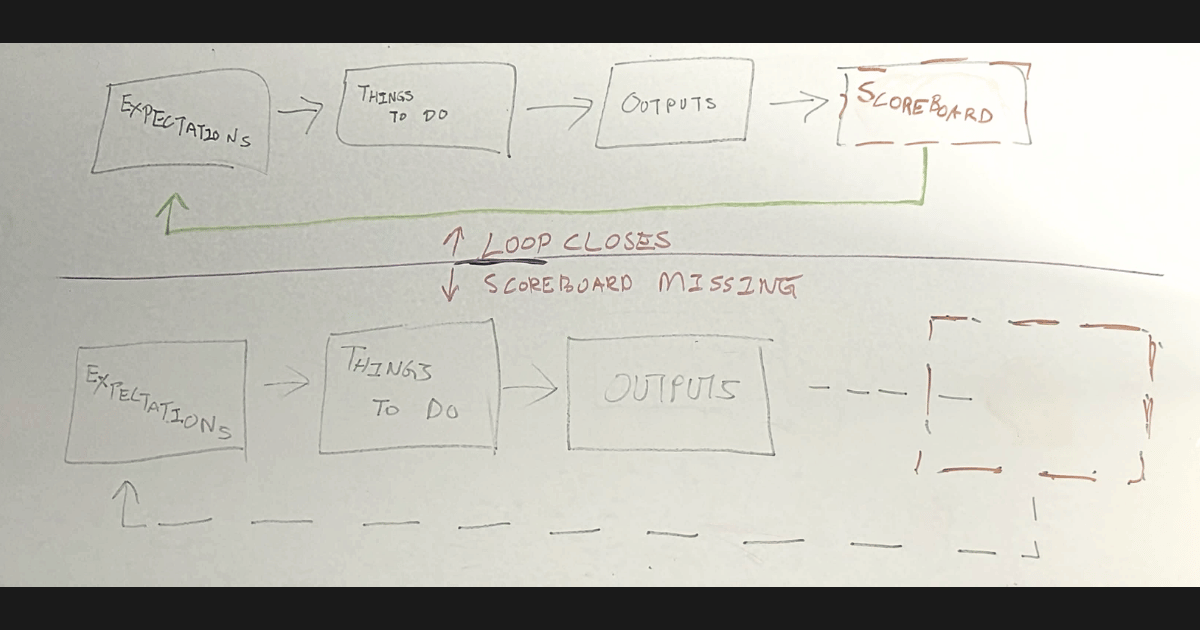
This applies to mentoring, to school, and to striving for things across many arenas.
It is particularly hard to have high expectations in fields that are not established, or are undergoing great change — no less if one was not modeled or taught how to have success through the translation of effort and attention to positive outputs.
In concrete terms, a fair number of early career individuals, or students of many varieties, find themselves in the position of having a sense of conviction about wanting to do something, but not knowing where to begin, or how they would fit in. (Whether the emphasis is on the “doing” or the “something” can be elaborated on later.)
Essentials
It is essential, then, to have ways of combining all of the above:
a model of high expectation
examples of translating attention, targeted focus, into hitting a target (“success”)
doing so in an accessible way (in general); particularly with awareness for how there are barriers to access or even exposure, no less how some fields are rapidly shifting
Herein lies the challenge of what I would see modern “teaching” in a unbridled, sober, and robust approach to it.
Other terms could be: pedagogy, coaching; research design, organization design, curriculum design (or replace design with the term strategy); mentoring, professional development, formation.
Why expectations matter
Expectations are related to the classic Streetlight Effect metaphor in the light of the lamp reveals what you are able to look for; expectations impact the scope or range of what you are able to aim for, and what targets are conceivable, perceivable.
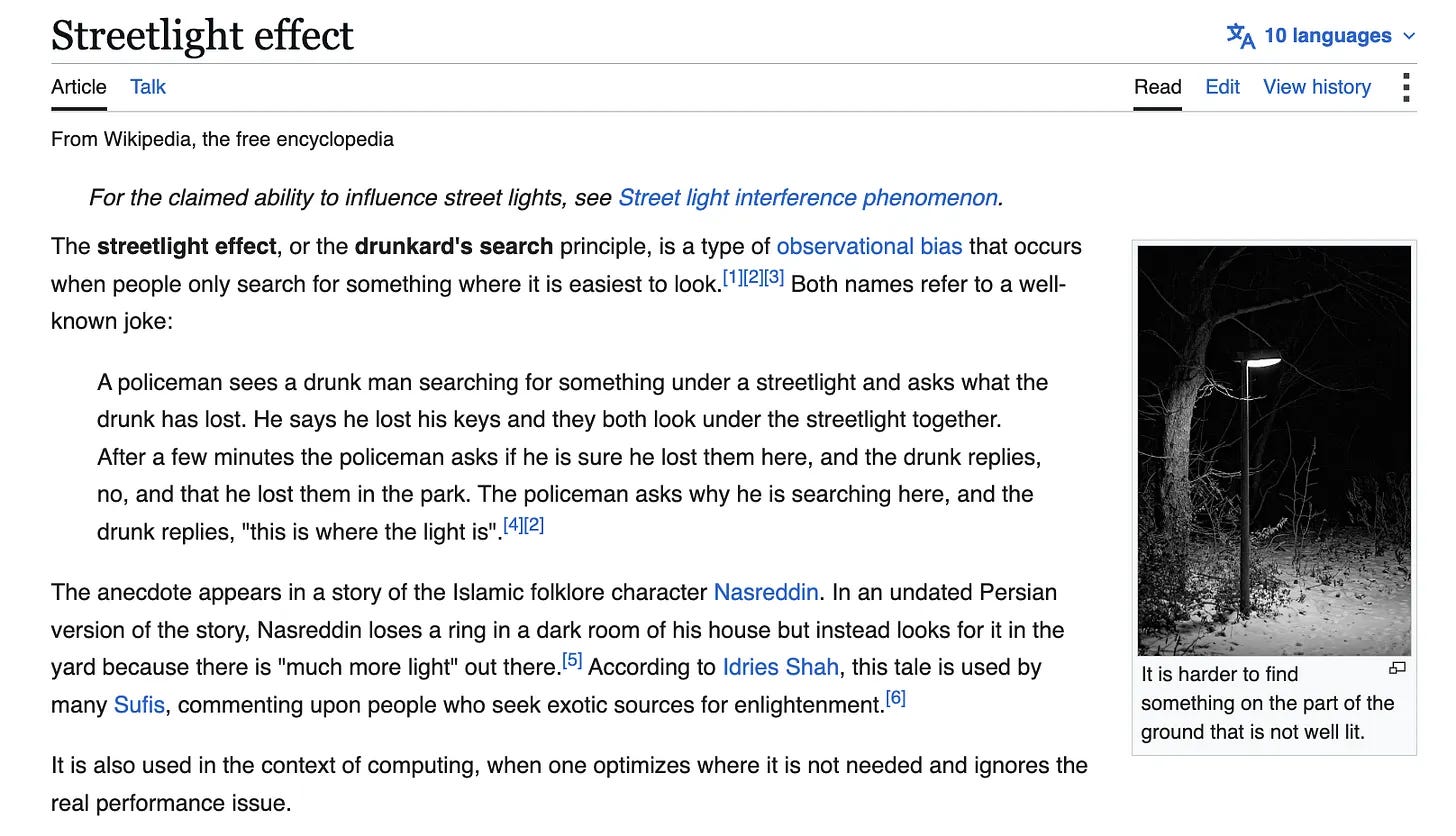
Abraham Kaplan named it the principle of the drunkard's search in The Conduct of Inquiry in 1964. A great deal of behavioral science, Kaplan thought, was spent on the questions that happened to be well lit rather than on the ones that mattered. What is easy to miss is that he did not think the drunkard was simply a fool. It can be reasonable to look where the light is, since that is where you can actually resolve something and rule possibilities out.
Expectations work the same way. The light governs what you can look for, and so it governs what you can aim at. This is rarely a matter of cowardice or low ambition. An unlit target is not yet a target; it is not yet something a person can be observed to be trying for.
In a more everyday sense, a personal anecdote about relationships fits here: when I was a much younger person, I found someone who I was deeply attracted to and very compatible with; we got along well, and years later realized that she was genuinely interested in me. But young Me had no clue that that was even a possibility, and not even out of a sense of self-defeatism; it was much more a sense of how I was not someone who’d be in that situation at all, so why would I consider this person as a potentially viable partner?
These are the stuff of various coming-of-age films and novels, assuredly.
But I put it in these ubiquitous terms to say it is the same thing for people on the cusp of getting towards buying-in to their ability to contribute to a field, to take up space, and for their voice and talents to be developed so as to meaningfully contribute.
It is often trivialized into or having sympathy for marginalized folks, but I would say12 it is essential to the work of creating alternatives or otherwise building anything that doesn’t already have a pathway.3
For a masterclass in recent history, consider Marva Collins [1] [2], whose results were real and, as it turned out, unscoreable.
The genuine cost of expectations
If you are guide or leader of people in any degree4, there is a fundamental labor of maintaining the balance between: trust or rapport; buy-in; and the ability to challenge or give feedback and correction of different degrees.
This is related to expectations in that there is a fundamental accounting. You may have heard terms like Emotional / Relational Bank Accounts, and Gottman Bids5 or Gottman Ratios. There requires consistent investments, and trust is earned or lost by how following the advice or leadership or vision you offer yields concrete outcomes that the recipient viscerally experiences.6 This all to say the consequences are real, and often harsh7 — and we have surprisingly little general education or preparation for what this is like as we are building or shaping things involving others in this way.
Elite Teams ↔ static external success measures
Mediocre people don’t like high achievers, and high achievers don’t like mediocre people. So if everybody doesn’t buy into the same principles and values of the organization — into the same high standard — you’re never going to be successful. […] Get the right guys on the bus, get ‘em in the right seats, and get the wrong guys off the bus. - Nick Saban
In terms of “elite, high functioning teams,” we will hear similar refrains from coaches. Nick Saban’s bus comments are famous; Urban Meyer’s coaching & leadership book title was Above The Line for his variant of the same principle.
This is a fitting approach to running an elite special operations program. It is unlikely to yield much if you are in a developmental state, and that’s ok; the point here is not to normatively argue which approach is better, but to functionally and strategically differentiate where things hold or not in terms of the developmental, inter/multidisciplinary work that is required to cultivate the alternatives we are looking for.
Why it works for elite programs: an elite football program, a top law firm, a special operations team, or related places where On/Off The Bus mentality is well-suited or even necessary have very particularly defined goals and win-loss conditions; there is an obvious structure that frames the cost structures and the trust & buy-in aspects.
To say this from another vantage point: there are clear and obvious ways for someone giving you their attention (recall: examples of translating attention, targeted focus, into hitting a target (“success”)) yields outcomes. In Saban’s sense, if you listen to him, you become a better football player, win games and championships, and increase your career earning potential.
These are visible, undisputed metrics and stable arenas; the NFL isn’t going away, pro-football players salaries are not in a decline, and in a fundamental sense, it is clear who wins or loses a football game by nature of heavily agreed upon scoring conventions.
This is not the case in all arenas.8
Why “bus talk” doesn’t fit for where we are
(at least not all the time)
We are in a world of flux; we are in a moment where economy, education, status, prestige, and success at large is at least in question if not in a moment of large-scale inertias and generationally-developed consequences are coming to a head as they inharmoniously mesh with past standards or conventions.9 Consider the value of a college degree, the previously mainstream arrival achievement of owning your own home, and other 20th century dreams. To some, each of these worked the way a football season works; you could tell whether you were winning, and so could everyone around you.
Now, consider the challenge of developing people to operate within an environment of flux and with domains and disciplines that have been developed for centuries, and have particular 20th century inertias that may or may not hold sway in 21st century life.
Consider young people’s growing angst about AI, declining mental health, sex, social interactions, and increasingly less clarity around what the future holds. No less, the murky spaces that tech empires and their founders are creating.10
Getting the right people on the bus may not be structurally viable here; the way to sustain or build buy in may not be able to rely on those existing structures.
Contextualizing recent examples may include Nader’s Raiders humble beginnings (thirty thousand applicants for two hundred dead-end summer job) but substantial impact, or the Macy Conference series midwifing classical cybernetics alongside many adjacent and downstream fields. See the Appendix.
So how do we cultivate high expectations in the 21st century for those building alternatives?
That will be the topic of the next essay in this series. This first part has been situating the arena of the problem, and juxtaposing it to existing conventions around high expectations and high functioning teams.
We have some groups showing how to do this, and I find almost all of the ones really developing intermediary cultivation spaces and then building out the structure for more conventional explicit things to be away from the lime light.
As I often say, I cannot point to many places that are doing this; academic institutions, nonprofits, think tanks, private sector, or startups. But they do exist.
For preliminary thoughts on what operating in this intermediary, developmental state would be:
Explicit discussion of and commentary on the essentials: modeling; translating attention to hitting targets; in an accessible, zeitgeist-aware way
Fluency in structural mechanics of achievement or development: as in, what are existing modes and models and pathways to conventional success in the domain; what are developing alternatives, and how to you have earnest conversations around such. How do you have earnest allocations of effort given different needs and opportunities.
Program and Project Management:
Making clear on-ramps as possible: pathways from conviction to skill or ability development to meaningful outputs.
Giving People “Things To Do”
There are more, but that discussion will take place in pieces ahead.
Closing the Loop: Expectations & Things To Do
A brief commentary on 3A and 3B: the former is inherently related to 1 and 2, the latter is, as I’ve come to experience it, one of the biggest bottlenecks and limiters, as obvious as it is. It is also what anchors to conventional or outdated frameworks for success, achievement, and everything else; they have “things to do” that are obvious , and even if not interesting or aligned to anything, the nature already existing — having-been-established — offers some manner of Return on Investment (ROI), and that affects trust/buy-in.
In a meta sense, Things To Do are the lifeblood in terms of the leadership or project management sense; or in terms of organizational or community offerings, in general.
Consider how it is hard to empower or maintain have high expectations if people don’t have targets to hit, and they don’t have targets to hit if there is not a consistent series of Things To Do.
So if you are someone involved in creating or maintaining Things To Do, you have to have them be useful or profitable, and ensure that they are aligned to or point towards something, and then perhaps you can cultivate high expectations within that space.
A way to think about this, in the Nick Saban or football sense, is that his arena is “well-lit” relative to the Streetlight11 metaphor. If Saban is asking you to do a particular drill that you don’t see why it would benefit you, if the trust is there, it is easier to do; if it leads to you succeeding at the drill, and getting more playing time, its easier to do; if it leads to the people who do the drill getting drafted and making big money in the NFL, its easier to do.
But if there is no drill to do,
— no less the associated or downstream tasks: no practice structure, no training regimen, no strength & conditioning program, no nutrition program, no support for academics (student-athletes in college), and no holistic sense of athletic maintenance and treatment of wear and tear —
then there is no means of cultivation, earned buy-in, and no chance of having grounded high expectations.
You might have ungrounded, or high expectations that are based off of good-faith or general belief, yes. But I think this is a trap that many organizations, from start-ups to nonprofits to other communities, fall into; the relative donation of conviction and high-expectation behavior, commitment, showing-up, etc — but without being based on consistent Things To Do. Particularly, Things To Do that actually lead somewhere.
What’s next
So there is an preamble.
In pieces ahead, I will go into many of these components. My time at JOPRO and elsewhere — conventional, alternative, and avant-garde organizations— has substantially shaped my understanding of what these elements are.
This discussion falls into the category of things I want to be more openly talked about, and so here is one opening of that conversation.
I would also briefly note that the means of being able to possess, to carry high expectations is something that is under duress here in 2026. I have spoken and written about “Apathy-Maxxing” as core part of the zeitgeist, and it would be remiss to not mention that in the context of everything above; many of the structural shifts that I pointed out have inherent ties to the challenges of cultivating in particular a skill, vocation, or passion of any kind.
Appendix: Three Arenas Without Scoreboards
Marva Collins
Collins left the Chicago public schools in 1975, put $5,000 of her pension into a school on the second floor of her home, and started with four students, most of whom the system had already classified as unteachable. The Washington Post, visiting early on, found a five-year-old working through the Canterbury Tales and a nine-year-old reading Nietzsche. By the time 60 Minutes ran its segment in 1979 the school had a national reputation, and enrollment eventually passed 200.
Outside of the high expectations hallmark, another part worth carrying into this discussion is what happened in 1982. Teachers, reporters, and a former staff member began pressing for independently administered results, and it emerged that the claim the coverage had been built on, that students gained five grade levels in a year, had never been externally verified. The one piece of independent testing anyone actually ran, by the admissions director of a nearby high school, found 45 Westside students averaging just over a grade level of reading gain in a year, which is a good result and nothing like the legend. Collins herself told the Times that year that she had never called herself a superteacher.
That is the position anyone doing this kind of work ends up in. The expectations were real and were being met by students nobody else expected anything from, and there was no agreed scoring convention that could settle whether it had worked.
Furthermore, how do you measure the impact of officially condemned, unteachable children being converted from lost causes to contributors? There is no instrument that measures what it is worth to a child the system had already written off to be treated as capable.
Nader’s Raiders
In the summer of 1968 Ralph Nader put seven law students onto the Federal Trade Commission. They spent the summer reading whatever the agency would release and interviewing current and former staff, and three of them came back over the Christmas break to write it up. The 185-page report appeared that January and called for the chairman’s resignation and a rebuild of the agency. Nixon asked the American Bar Association to look into it; the ABA commission, chaired by a lawyer who would shortly be running the FTC himself, agreed with the students. By the second summer there were 200 positions and roughly 30,000 applicants, with the center’s director estimating that a third of Harvard Law School had applied.
There was no bus, in the Saban sense. These were summer jobs at an outfit that had existed for a year, with no career track attached and no field to enter afterward. What there was instead was a specific agency, a specific set of interviews, a deadline, and a report that would be published under their names. FOr what its worth, the first four reports sold over 450,000 copies combined and the FTC did get restructured.
Macy Conference Series
The Josiah Macy Jr. Foundation ran ten conferences between 1946 and 1953, initiated by Warren McCulloch, under the title “Circular Causal and Feedback Mechanisms in Biological and Social Systems.” Wiener, von Neumann, Shannon, Mead, Bateson, and Licklider were in the room, arguing across neurophysiology, anthropology, mathematics, and engineering. The word cybernetics was not attached to the series until the sixth meeting in 1949, and the first five produced no published output at all. There was no department, no degree, and for most of it no field to be credentialed in.
The formation mechanism is the detail I would point at. Heinz von Foerster arrived from Vienna in early 1949 barely able to speak English, presented a paper at that sixth conference, and was made editor of the transactions, in his own account partly so that his English would improve. Editing the proceedings put a newcomer at the center of the field’s live argument for five years. He came out of it as one of its central figures and went on to found the Biological Computer Laboratory.
See my forthcoming manuscript “Harvesting Magicite”
See the language around systemic exhaust I am developing with Jennifer Jiang
See an essay on survivorship bias, and forthcoming manuscript on repitiveness
Actually to be read as: if you interact with humans to any degree; it’s not just about formal leadership positions; every relationship (or even polyvagal theory sense of central nervous systems interacting with each other) has particular choices being made about how you interact with other entities.
Through my own work and some colleagues at JOPRO’s Mental Health Paradigms & Perspectives, we are releasing soon a paper on another kind of bid related to an individuals deeper flourishing and the social environments that are conducive to such.
See the “Leading a party of travelers through dangerous cavernous depths” metaphor
G.A.B.O.S., if you will
The general form of this is that a search strategy is only as good as the structure of the space it is searching. On a smooth landscape with a single peak, incremental local improvement reliably gets you to the top, which is what the drill-to-playing-time-to-draft gradient is. On a rugged landscape with many local optima, the same strategy strands you on a small peak quickly, and getting anywhere better takes recombination, longer jumps, and a tolerance for temporarily doing worse. Kauffman’s NK model is the standard treatment (Kauffman and Levin, “Towards a general theory of adaptive walks on rugged landscapes,” Journal of Theoretical Biology 128, 1987; and The Origins of Order, 1993). James March’s exploration and exploitation distinction names the same tradeoff at the organizational level, including the reason exploitation wins by default: its returns are nearer, more certain, and easier to attribute.
An irony here is that this may also apply to college football within the USA itself; with NIL and players earning money, and massive major-conference realignment, there is increasing stratification between the D1 conferences, as well as increasing calls for legislation and governing bodies to sort out things like salary caps or more standardization of rules. We are in a time of relative chaos, there, too — in a way that monetization, commercialism, and productization are influencing other economies and ecosystems of interaction, as well.
I am indebted to a Data x Direction intern for pursuing her Summer 2026 project to the extent that these sources and many fruitful discussions resulted.
One more pass on the Streetlight effect: what I’m arguing for isn’t abandoning the lamppost simply to be contrarian, it’s that somebody has to go build lamps in the park.