

Two years ago I wrote a walk through the 1943 paper by Arturo Rosenblueth, Norbert Wiener and Julian Bigelow, the short essay that gave cybernetics its first working vocabulary for purpose and feedback. Near the end of that post I noted, mostly in passing, that the authors had made “an attempted disclosure of limitations or suppositions” alongside their claims; the paper has many reasons to be referenced as a landmark upstream of modern sciences, but my recent work on alternatives and research design lends to another pass around these stated limitations.
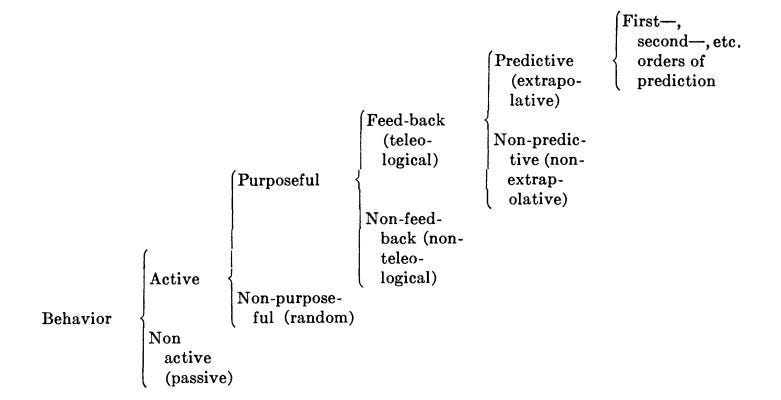
Their disclosure arrives early. In the paper’s second paragraph, the authors define their behavioristic method: take an object, look at what goes into it and what comes out of it, and study how the two relate. The third paragraph says what that leaves out.
The above statement of what is meant by the behavioristic method of study omits the specific structure and the [intrinsic] organization of the object. This omission is fundamental because on it is based the distinction between the behavioristic and the alternative functional method of study. (p. 18)
The point worth slowing down on is the word fundamental. They are not apologizing for a gap; they are saying the gap is the method, and that the line between their approach and a study of internal organization runs exactly through it.
The word I have been using for this move is bracketing: setting something aside on purpose, and saying so, so that the rest can be studied without it. The authors never use the word.1
Philosophers of science have finer words for nearby moves. Abstraction leaves features of a thing out of the account. Idealization puts in features known to be false, a frictionless plane or an infinitely large population, because the distortion makes something tractable. Scope conditions and ceteris paribus clauses do related work, marking where a claim is meant to hold. By those lights the 1943 paper practices abstraction, and declared abstraction at that: it leaves the inside of the object out and writes down that it has done so. Bracketing2 is the name I am using for that second part, the writing down, at its best, the examination of why, how, and the choice’s coupled costs and benefits.
What the bracket bought
With the inside of the thing set aside, very different things become comparable. A torpedo with a target-seeking mechanism, a cat moving toward where a running mouse is about to be, and a patient carrying a glass of water to their mouth all become objects that produce behavior, some of it purposeful and some of it corrected by signals from a goal. The paper’s payoff, stated on its second-to-last page, is that one behavioristic analysis applies to machines and living organisms alike, regardless of how complex the behavior is.
That claim is much of why the paper still circulates. It is the root of the substrate-neutral ambition that runs from cybernetics through to work like Michael Levin and Josh Bongard’s argument that living things are not machines in the twentieth-century sense.3 None of that comparison was available until something had been set aside to make it possible.
Caring is declaring: (the aim of) making brackets explicit
What I did not appreciate in 2024 is how consistently the authors do this. Internal structure is only the first thing they set aside, and each time the move is the same: here is what we are leaving out, and here is roughly why.
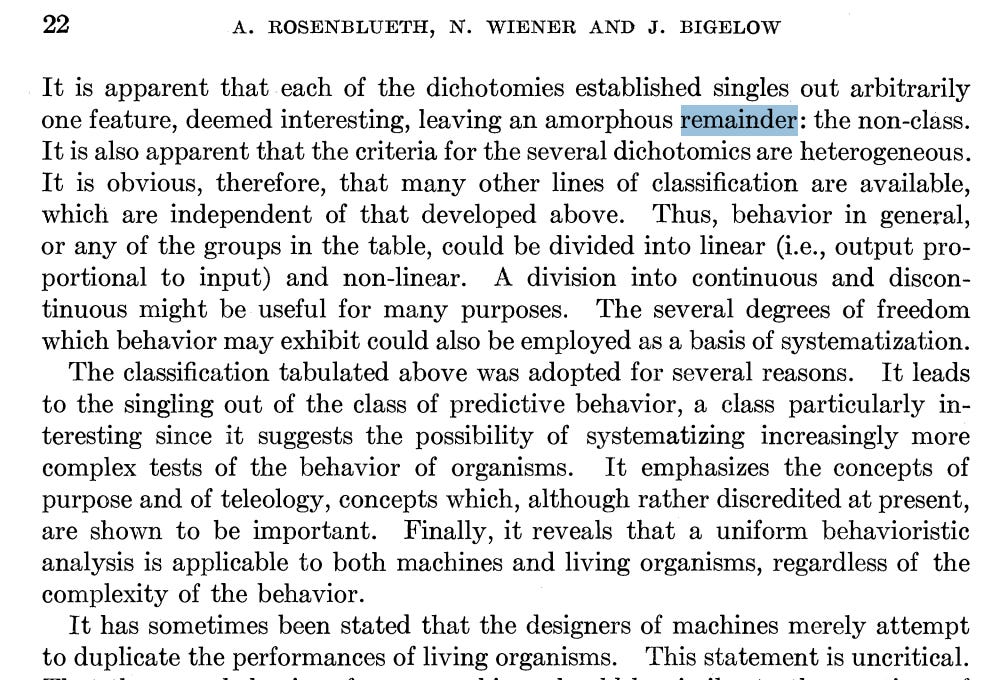
On purpose itself, they concede on p. 19 that their definition is vague enough to be largely meaningless as an operational test, and then argue the concept is useful enough to keep anyway. On their own classification scheme, they admit on p. 22 that each split singles out one feature they happened to find interesting and leaves an “amorphous remainder,” and they list other schemes that would serve just as well, such as linear against non-linear or continuous against discontinuous. On causality, determinism and final causes, the old philosophical weight that teleology carried, they state on p. 23 that a discussion is beyond the scope of the essay, and they say exactly which part of the old meaning they are dropping.
It is a seven-page paper which keeps telling you where its edges are.
Where the inside comes back
The moment I find most interesting is on p. 21, three pages after the bracket goes up. The authors are sorting predictive behavior into orders, the cat that predicts the mouse’s path, the stone thrown at a moving target, the arrow. Partway through, they concede that the internal organization of the behaving thing limits what it can do. A machine meant to track a moving light needs more than a photocell; it needs a structure adequate to interpret what the photocell reports. The nervous system of a rat or a dog, they suggest, probably does not allow prediction of the third or fourth order.
So the inside comes back, in the middle of the behavioristic analysis, because their own subject required it. They do not hide it. They let it in and keep going.
On p. 22 they draw the boundary outright. The behavioristic analysis of machines and organisms is “largely uniform,” but their functional study reveals “deep differences”: organisms are mostly colloids and proteins, machines mostly metal; nerves conduct with ions, wires with electrons; the eye multiplies in space with millions of rods and cones, where a television receiver scans in time. The famous line about the ultimate model of a cat being another cat closes that same passage. The authors knew where their method stopped seeing, and they mapped that edge themselves.
The authors treated the bracket as part of their method. I have come to think of it as closer to an instrument: something that lets you see by excluding, and that is trustworthy to the degree its range is stated.4 A declared bracket is an instrument with its range printed on the side, and p. 21 is that instrument reaching the edge of its range and reporting it.
The undeclared kind
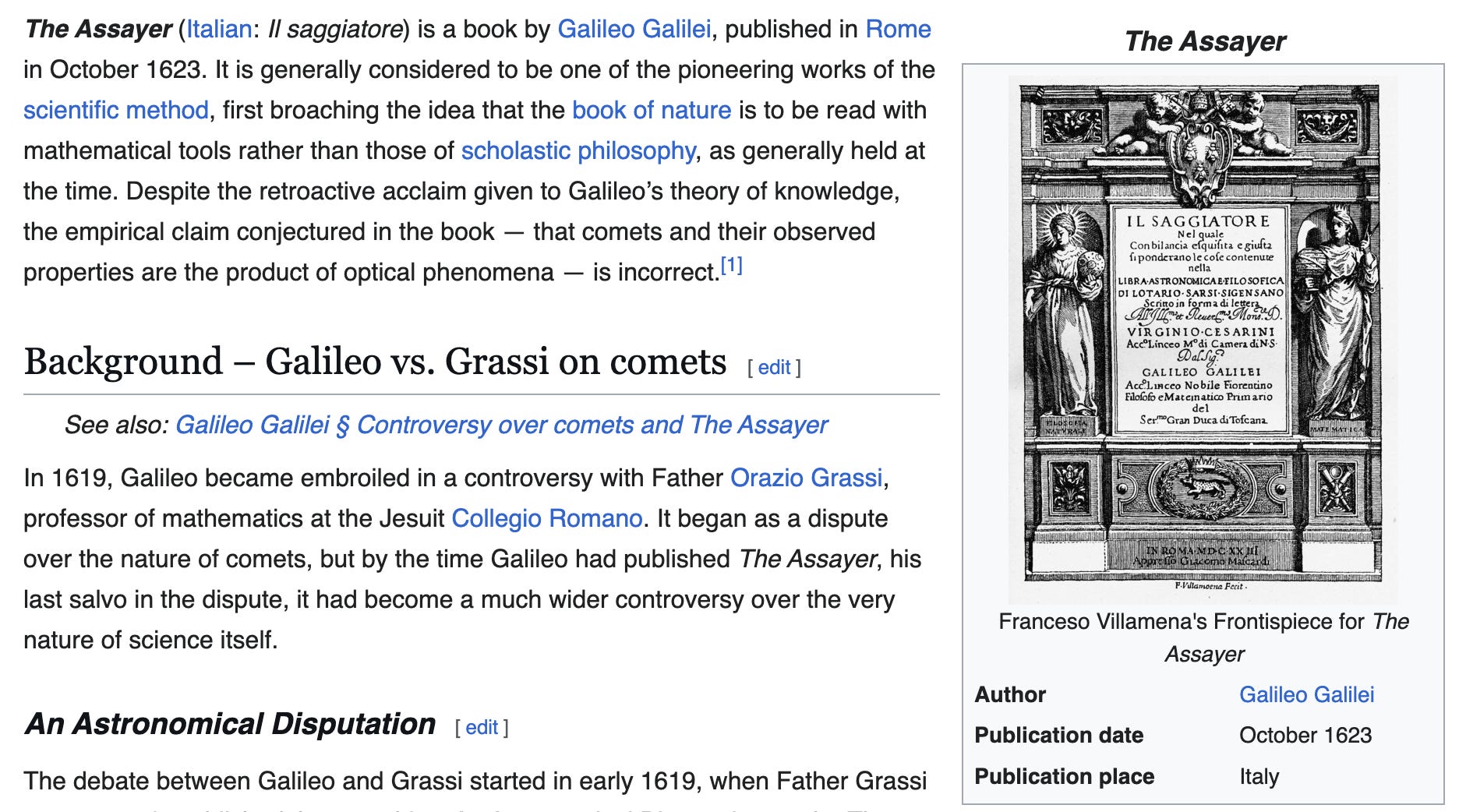
Compare a much older bracket. In The Assayer in 1623, Galileo argued that colors, tastes and warmth exist only in the one perceiving them, which left measurable quantity as the proper business of natural science. That was also a decision to set something aside so the rest could be studied. It worked extraordinarily well. But it was offered as a fact about the world, and it was rarely treated as a choice that could be revisited.
In “The Questions We Stopped Asking”, Avery Lim (Avery Lim) and I trace part of what followed from moves like that one: how holistic, felt, whole-system inquiry gradually lost its standing in science, and what of it may be worth recovering. Reading the 1943 paper again next to that history, I continue to notice how the setting-aside was handled. A bracket that is named stays visible as a decision someone made, with reasons, and it can be reopened when the reasons change. One that goes unnamed tends to become the shape of a field, and the questions it set aside slowly stop looking like questions.
The bracket under fire
A declared bracket also gives critics something to grasp, manipulate, or pull on. In 1950 the philosopher Richard Taylor challenged the paper in the same journal, in “Comments on a Mechanistic Conception of Purposefulness.” Later readers have summarized his objections as aimed largely at the “black box” behaviorism underneath the definitions, and at whether purpose can be identified at all without reference to an agent’s beliefs and desires. In other words, he pushed on what had been set aside.
Rosenblueth and Wiener replied, and Taylor answered again, granting that they had clarified their position and holding that fundamental questions remained.5 I read the exchange as the declared bracket doing its job. There was a visible seam, and someone could find it and argue about it in public.
In the rejoinder Taylor finally sets out his own view, which ties purpose to an agent’s beliefs and desires, tacit ones included, and credits the analysis to the philosopher C. J. Ducasse. The disagreement, in the end, was about whether the inside could stay bracketed at all.
Three questions
I am working with colleagues on a version of this question across the sciences of mind and agency: what each field set aside in order to work, and whether it said so. I’ve also considered it from the ethical side, in a short 2023 note on Michael Levin’s remark that ethical and social frameworks will become essential as the kinds of agents around us diversify. Understanding like that has a retrospective effect, if not a retroactive one: it shows what earlier frameworks were missing.6 The 1943 paper has become a primary reference case, as it offers three questions of particular use for the investigations I’m particularly interested in, the way you would check an instrument’s range before trusting what it shows.
What did it set aside in order to work?
Did it say so?
Did it say what that cost?
Rosenblueth, Wiener and Bigelow answer all three in seven pages. Most of what I read answers the first only if I go looking, and usually without anyone meaning to hide it; the setting-aside was simply never written down. That makes me wonder how many of the questions we treat as closed were only ever set aside, and who would know to reopen them.7 A setting-aside that nobody wrote down is one of the quieter ways a field comes to feel as though there is no alternative.
On the word. Bracketing is borrowed loosely from phenomenology, where Husserl’s epoché means suspending assumptions about the world’s existence in order to study experience as it appears. That is a related move, though not the same one. Cybernetics soon had its own word for the 1943 version. The term “black box” entered cybernetic discussion in the early 1950s; Ashby’s journal records Wiener raising “the problem of the black box,” and Ashby gave it a full chapter in An Introduction to Cybernetics (1956). Bruno Latour later named the opposite drift. In Pandora’s Hope (1999), he describes blackboxing as the way scientific and technical work becomes invisible through its own success: once a machine runs well or a fact is settled, attention narrows to inputs and outputs, and the more something succeeds, the more opaque it gets (p. 304). The cybernetic black box is a bracket chosen and declared; Latour’s forms on its own and is forgotten. That is close to what this post calls an undeclared bracket.
The word has a third, quite different life in qualitative research. There, bracketing means researchers setting aside their own preconceptions so those color the study less. Lea Tufford and Peter Newman’s “Bracketing in Qualitative Research” (Qualitative Social Work, 2012) is the usual reference, and it traces the practice to the same phenomenological source. The direction is reversed: qualitative researchers bracket what they bring to the object, where Rosenblueth, Wiener and Bigelow bracketed part of the object itself. The two share one habit worth keeping, which is writing the bracket down. Tufford and Newman suggest memos and even “bracketing interviews” for exactly that.
Or perhaps, “documented bracketing” would be more ideal.
The machine question since. Bongard and Levin argue that most claims that living things are not machines rest on an outdated picture of what a machine is, and they call for a conception of “machines as they could be.” The sharpest statement of the opposing, organicist case is probably Daniel Nicholson’s, for example “Is the Cell Really a Machine?” (2019), which argues that newer single-molecule data fit an engineering picture of the cell poorly. Bongard and Levin followed in 2023 with a paper on “polycomputing”, arguing for an observer-dependent view in which hard category boundaries give way to a continuum. Levin pushed further in a 2025 Noema essay, “Living Things Are Not Machines (Also, They Totally Are)”. His claim there is that no system, living or engineered, is fully captured by our formal model of it, and that “machine,” “computational” and “cognitive” are best read as proposals for how to interact with a system, judged by what they let us do. One of the essay’s figures is adapted from the classification diagram in the 1943 paper. That is close to this post’s argument: a declared bracket keeps the limits of a model visible as limits. For a careful survey of the wider debate, see Ann-Sophie Barwich and Matthew James Rodriguez, “Rage Against the What? The Machine Metaphor in Biology” (Biology and Philosophy, 2024), which stresses that the metaphor runs in both directions. Eighty years on, the argument has turned around, and the open question is whether anything at all is only a machine.
All models are wrong. The statistician George Box’s line that all models are wrong but some are useful is the version most people know. The familiar wording comes from Box and Draper’s Empirical Model-Building and Response Surfaces (1987), but the idea is already in his 1976 paper, “Science and Statistics”. There he takes it a step further: since every model is wrong, the scientist has to stay alert to what is importantly wrong, and not worry about mice “when there are tigers abroad.” A declared bracket is that advice put in writing. It says how the model is wrong, so others can judge whether it matters. Rosenblueth and Wiener made a related argument two years after the 1943 paper, in “The Role of Models in Science” (1945). No substantial part of the universe, they wrote, can be grasped without abstraction (p. 316). Hence the best material model of a cat is “another, or preferably the same, cat” (p. 320). Partial models were all science had, and they took that as a fact about the finitude of the human mind, without defeatism. Korzybski’s “the map is not the territory” (Science and Sanity, 1933) belongs to the same family.
An earlier version. In a footnote to his rejoinder, Taylor points out that Ralph Barton Perry’s “Purpose as Tendency and Adaptation” (Philosophical Review 26, 1917, pp. 477–495) set out a thesis “virtually identical” to the 1943 paper’s, down to the thermostat and the steam-engine governor as examples (p. 488). He also points to Stevenson Smith’s “Regulation in Behavior” (Journal of Philosophy 11, 1914) for plenty of what Rosenblueth and Wiener would call teleological behavior, described there as auto-adjustment with no mention of purpose. The 1943 move had at least two decades of quieter precedent.
For me, this is a key feature of a particular line of inquiry in development over this past year. In the positive sense of technology, opportunity and time — compared to the various negativities and legitimate dismay that the year 2026 presents us with — I have good prospects that there has never been a better time to examine such things, and to earnestly consider their opportunity costs. Such value, and associated wisdom, may be indispensable for pursuing vital pathways, including meaningful alternatives, during the rest of this century (and beyond, for those that are particularly concerned about their non-metaphysical afterlife.)
A later bracket. Howard Gardner’s The Mind’s New Science (1985), a full-scale history of cognitive science, names five features of the field. The third is a deliberate decision to de-emphasize emotion, historical and cultural factors, and background context, factors “whose inclusion at this point would unnecessarily complicate the cognitive-scientific enterprise” (p. 6; he returns to it in ch. 3, p. 41). That bracket was declared, and marked as provisional. Whether it was ever reopened is a separate question. Gardner’s history also counts “the cybernetic synthesis” among the field’s founding inputs (ch. 2, p. 19), so the two brackets sit in one lineage.
After original publication, I added the present footnote #4 on "all models are wrong"; this came up in many preceding discussions about this but was never stated in the post.