

I don’t think the world is prepared for the coming generations that are informed of all of the bogusness and false promises that are clearly bunk and roads to nowhere, and committed to wanting alternatives.
They are looking for what to do and what to build and how to contribute, and are building a discipline in doing so that their former generations neglected to cultivate.
Yes, many are tuned out, part of “The Anxious Generation”, and otherwise caught up in avoiding ‘cringe’ at all costs — but the ones that are aspiring otherwise will be ready to push things forward in unprecedented ways. (See appendix for some specifics.)
For those that have come to see where the work is to be done, and haven’t been captured by the apathy-attention-economy of the 21st century: I salute your efforts of keeping your eyes open and finding your bearings.
The world will be in your hands, and there are those looking to soberly and constructively contribute to those ends. There are those looking sell you some bridges and hype up bridge-building to nowhere, too.
But if you choose wisely, there are chances and opportunities in the coming years that have never existed before.
- Jes
See also:
Yes, It Is Dangerous to Go Alone

That line has lived in gaming culture for forty years. An old man in a cave hands you a sword. It’s not much, but it’s something. It’s an acknowledgment that what you’re about to face is real and difficult, and that someone who came before you cared enough to
A note on Community & Leadership in the Wake of Stability

In a time where performative (or desperate) gestures of confidence may get more air-time than wisdom, I want to offer something else: a reflection on what it means to live, generate sustenance, and collaborate through uncertainty—especially when visions are shifting, leaders are faltering, and the ground beneath our feet continues to move. This post be…
and:
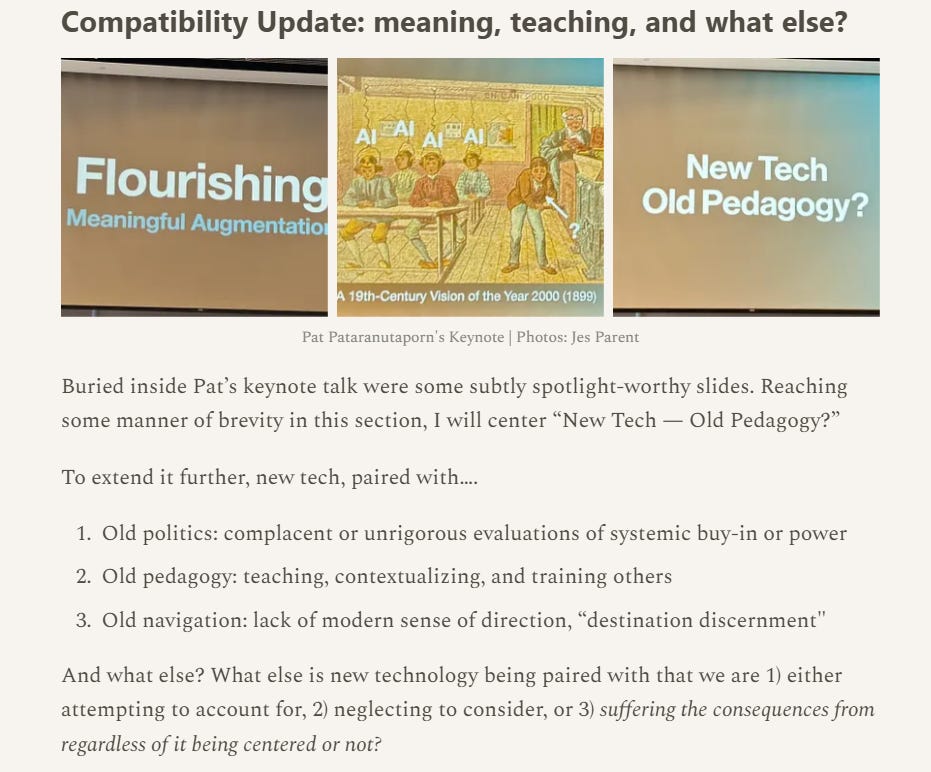
Compatibility Update: meaning, teaching, and what else?
Appendix: Some characteristics I’m observing
With additional commentary below.
Being supremely “over” the (clout and respect given to) political-economic establishments of the 20th century. You can see one branch of this that has aligned with the Tech-Right, but even some of those are increasingly disenchanted. I would say, there is ultimately an agonistic approach to both anarchy and conservatism; it’s a fatigue or tiredness of the older generations and their partial updates to the structures that served them in times that don’t quite exist any more. Specifics:
The USA has shown many of its cards in terms of its capabilities and capacities; it is not a bastion of something sacred, it is a country with sets of ideas that have to be very intentionally fought for — like anywhere else.
The world has proven itself that it is currently uncapable of taking reasonable action to prevent obvious things that should not happen, on the World Stage. I don’t think many older generations truly comprehend this impact on younger generations yet. What was conspiracy or fanciful thinking or “too far away to make sense” is not, any more; those excuses and distancing do not hold the same way. The legacy clout of World War 2 will fully be lost 100 years later1
Actively aware that legacy educational institutions are inadequate at preparation for both jobs and substantive knowledge generation.
Don’t mistake this as a call for destroying the university or “purging” them as some of the populists or revolutionaries have called for elsewhere. But rather, it’s simply and bluntly evident to those who are looking to see. From busy work to empty degrees to being unprepared to address real challenges, the autodidact and enclave and residency approaches to education are taking off. Why? Because there is not really anywhere else to go.
The thing to be aware of here is that while established institutions have the funding and the clout-generating capabilities — for education; for Frontier AI Labs and Big Tech, there is a slightly different approach to fragmenting and splintering off — the generation I’m talking about is specifically growing it its commitment to build that which does not yet exist, whether or not the legacy institutions can adapt to the talent or vocational demands of it. A wildcard here will be just how much AI does impact jobs, and what it offers or does not offer for the economic reward loops downstream.
Disinterest in the conventions and trapping of success that successfully anchored or rewarded 20th century (or earlier) sense of social mobility, “arrival”, or otherwise a stable, predictable life.
See also: Twentieth-century dreams, on a long enough timeline
In short, the carrot isn’t the same carrot, and the nature of the stick is changing.
There are likely more clusters to be remarked upon, but I find most discourse around the younger generations as collectively missing this, and offering little in the acknowledgement of these changing tectonic-plate-level changes at hand.
What, So What, Now What?
So what to do about it? I’m writing and speaking more and more about this as time goes by, and my advice for those in mentorship, guidance, or otherwise supporting roles are:
acknowledge the unprecedented time;
don’t wuss out and throw hands up in the air and declare how glad you are to be retired soon or make some glib remark about how much easier it was when you were younger (personal point of preference on this one);
stand with the younger folks in solidarity and with facing the challenges together — the world has changed in dramatic ways and its ok.
The difficulty of the moment is that everyone’s sense of future — and the credibility of the achievements of the past — is called into question. And that hurts, and that’s painful, and that is a particular kind of grieving that collectively has not at all happened yet; I would even say, much of the fits and stutters and shaking-of-fists in the first decades of this century are simply because “We” collectively don’t really yet even know what to target, or how to support each other in providing space for the visions of the past, present, and future that hold meaning.
So, as much as you can, sit with the people around you in these truths, hardships, and opportunities. Wisdom from the past isn’t lost, but if you can earnestly connect it to the moment, that is something. The difficulty of the Future Shock (1970) → Present Shock (2013) → Present Day (2026) transition is that there is a leveling of how much experience actually matters, and we have very little Language, Models, Artifacts, or simply spaces or structures, to process that means.
We’re all dealing with this mostly alone, mostly isolated. There is no manual, and few historical precedents here.2 Some have likened this to a new axial age,3 and that fits somewhat better than “industrial revolution'“ or “AI is the new electricity,” to me.
I don’t have a magical, or grounded, solution to pitch beyond this yet. But I am working with others to detail some of the methods to provide the solidarity noted here, and more so, how to earnestly pursue real alternatives in a time where they in dire need.
I’m trying to more openly model the means for collaboration around these things — so feel free to reach out to me to discuss more of any of these points. Furthermore, some programs and opportunities will become available in the months ahead for institutions I’m a part of, so be sure to check their respective announcements as “Things To Do” become further developed.
This is why many things are happening now, in 2026, to try to cash out while there is cash to be withdrawn.
Yes, I particularly distance here from “it’s like the next industrial revolution,” as it’s not just a shifting of scale, or development of cities, or more rapid production. There is an informational and navigational impact at play, with less clear metrics (related to high expectations) for success.
I actually have an essay around this, too, which I will publish on this blog.