

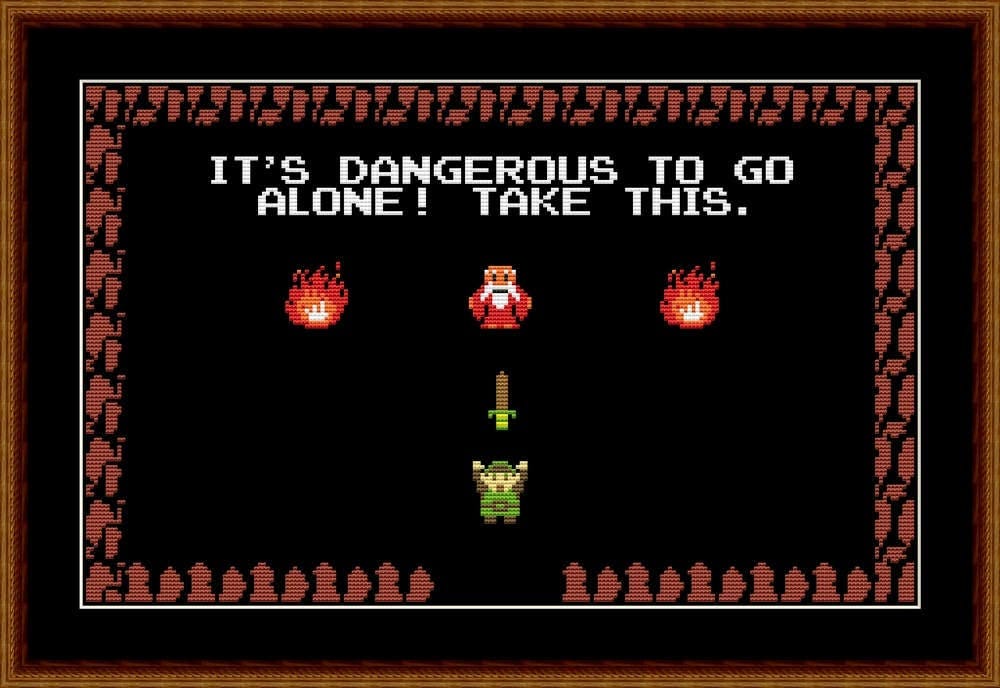
That line has lived in gaming culture for forty years. An old man in a cave hands you a sword. It’s not much, but it’s something. It’s an acknowledgment that what you’re about to face is real and difficult, and that someone who came before you cared enough to say so. And to put something in your hands before you walked out the door.
Another month passes, another conversation reinforces the sentiment: I don’t think we’ve done that. Not well enough.
The “Professors as Customer Service Associates” analogy (rather than stewards of learning) has stayed with me for weeks now. A colleague used it offhandedly, but it landed hard, because it describes something I keep encountering across the survey of graduate programs and learning environments we’ve1 been looking at: an institutional posture oriented more toward satisfaction metrics than toward the actual, difficult work of cultivating understanding.
This isn’t about bashing professors2. Many are doing extraordinary work under deteriorating conditions. But the structural incentives have shifted, and the results are showing. According to the Lumina Foundation-Gallup State of Higher Education study, only 35% of Americans now say a college education is “very important”, which is a dramatic slide from 70% just over a decade ago. Among those who lack confidence in higher education, a recurring reason is that institutions aren’t teaching the right things for the world students are actually entering.
Meanwhile, 87% of Gen Z workers report feeling unprepared to succeed in the workforce, citing limited guidance, unclear pathways from school to career, and uncertainty about which skills and credentials actually matter. This is not a marginal finding. That is a generational signal.
There are entirely different arenas and qualities of work and learning across these programs and spaces. Folks are looking for real teaching and real learning, and the migration away from conventional academia — even toward TikToks and shorts — makes a certain kind of sense beyond just the soundbite orientation. For a true seeker of knowledge, it’s “water, water everywhere,” but most of the readily available, institutionalized “drinking glasses” offer the appearance of cultivation, promise some kind of certification, yet land as hollow.
So here we are on Substack (and the increasingly commodified “digital third spaces” of social media) wandering3 in and out of collectives who care, and who dare: to auto-didactically scour the internet, employ critical thinking, and glue-stick-together something like a mosaic of understanding. (Gluestick, as in, something partially adequate but relatively rudimentary for the real work.)
It’s Ok to Say It
I want to name what I think is actually happening, because I think younger generations already know it in their bones even if nobody in authority has said it plainly to them.
The training and preparation you received was not adequate for the moment you’ve inherited. And that was true before GPT, before LLMs went mainstream, before the last five years of technological acceleration made it impossible to ignore.
The problems were already there. Universities structured around disciplinary silos that fragment knowledge precisely when the world’s challenges demand integration. A job market increasingly disconnected from the credentials institutions sell: only 11% of business leaders reported strong agreement that graduating students have the skills their businesses need. An epidemic of loneliness that the U.S. Surgeon General declared a public health crisis in 2023, noting that roughly half of American adults were already experiencing it before the pandemic. A demographic enrollment cliff now arriving on schedule, exposing how many institutions were running on momentum rather than mission.
The World Economic Forum’s Future of Jobs Report projects a net 78 million new roles by 2030, even as 22% of current jobs undergo structural change, and 63% of employers cite skills gaps as their primary barrier. Entry-level job postings have declined 29% year-over-year. Gen Z is adapting; they’re resourceful, they’re building side hustles, they’re self-educating. But they shouldn’t have to be doing this much of the orienting on their own.
This wasn’t sprung on us. We watched these trends compound over decades.
Being negative vs. being sober
“…pessimism too will turn out to be one more cultural luxury that we shall have to dispense with in order to survive in these hard times.” - Alasdair MacIntyre
I know there’s an instinct to hear this as blatant negativity, or as a dismissal of the good and hard work many people are doing. I don’t mean it that way. I’m around many projects and groups working diligently to address these problems meaningfully. I’m working on them myself. And I’ve written about the need for community, leadership, and accompaniment in this kind of moment: the messy, honest, co-regulatory work of figuring things out alongside others whose worldviews are also shifting.
But I think it’s important to periodically just say it4: we are underprepared. What we have at the ready is, by and large, inadequate relative to the scope of the concerns younger generations are now facing. The tools, the institutions, the frameworks, the mentorship pipelines — they were built for a world that no longer exists, and we have not rebuilt them fast enough.
It’s somewhat uncouth to try to normalize this. People will hear defeatism, or deny the good work of many. But I’ll say it again here, because I think it deserves acknowledgement, and because I think younger folks deserve to hear it from someone with enough experience to say it without hedging:
You were given a difficult hand. The world you walked into was not well-prepared for you, and you were not well-prepared for it. That’s not your fault. It’s a collective failure of imagination, investment, and institutional will. And some of us see it clearly.
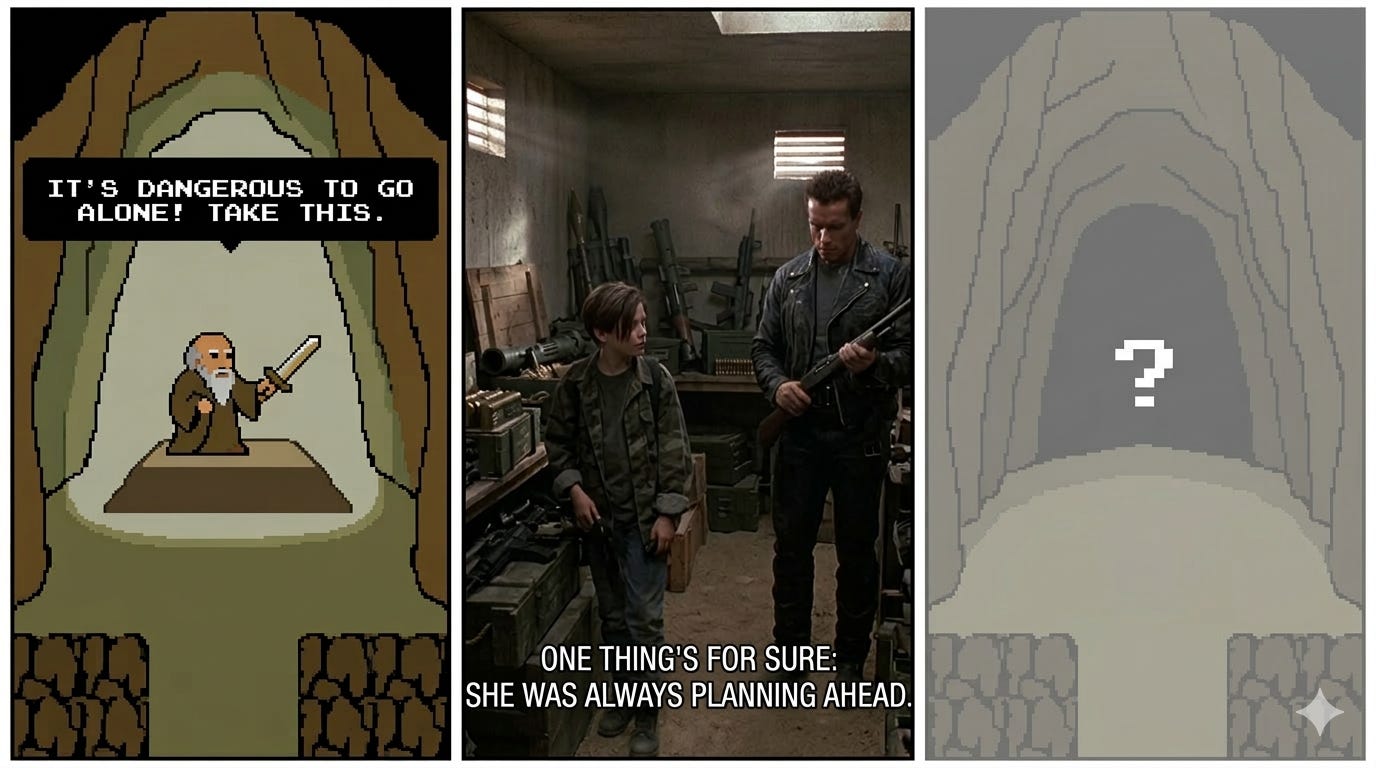
Building a community for those interested in working on what goes in that third frame. If you’re interested in more updates, consider following along on:
Creating space for informed agency + constructive optimism
Many in the futures space, the big idea space, the tech space, are clinging to certain conclusions, as speaking with certainty is the intra-domain politically correct approach, or because there are simply poorly articulated alternative views that don’t descend to extreme positivity or negativity.
I’m less interested in those poles, or the reduced dimensionally of the problem space at large. What I’m interested in is what an honest accounting sounds like, and what it makes possible.
Because here’s the thing about the old man in the cave: the sword isn’t the point. The point is the acknowledgment. It’s dangerous to go alone. Someone saw the terrain, named the difficulty, and offered what they had. That act of honesty is itself a kind of preparation. Or more so, an earnest effort at continuity, shared responsibility, and acknowledgement of trans-generational skin in the game5.
If we can do more of that — name what we failed to build, name what the moment actually requires, and then get serious about building it together — then the acknowledgment becomes a foundation rather than a eulogy.
There’s a longer piece coming on what I’m calling “The Right to Be Unimpressed”; a deeper look at how much of what’s available genuinely isn’t meeting the demands of the moment, and what it would take to build things that do. For now, consider this a periodic reminder: some of us see it, some of us are saying it, and some of us are ready to act on it.
General disclosure: I am involved in numerous activities around mentoring, developing, training, advising, and consulting both young folks and the people hiring and training them. From startup accelerators, to actual higher education practice, to advising and professional development services; and, across several timezones, domains, and cultures. My critique, to name a domain, is mostly centered, but not limited to, the American education & vocational preparation system.
I am deeply indebted to many professors who fought against the currents that I am describing, often going out of their way to make time and space for me. Many projects, spinoffs, and even companies have come from those seeds that they helped sew or cultivate. What I say here is not to bite that hand that fed me, but to pay witness to the hands that are tied. I would furthermore say that many people who want to “do away with higher education altogether” and yet don’t fully sit with the realities I am pointing at are also, unfortunately, missing the mark.
“A New Hope”: many are realizing community-forming is essential to the work at hand; wonderful programs at established institutions are doing what they can to reach out, to connect to network. Many of them I am increasingly covering on community news updates at blog.jopro.org. Please follow the JOPRO Substack and sign up here if you are interested in details about forthcoming related opportunities.
Being able to say it serves as an interesting litmus test to what visions of the past, present, or future your interlocutor is clinging to. As well as what part of the world-view updating process they are a part of.
Without being condemning, I’ve been in far too many professional development, advisory, or otherwise preparatory sessions where senior speakers essentially amount to saying “well here’s how it was in my day, and thank goodness I’m about to retire.” We need our elders in the game, and we need our young people to feel continuity across generations; this has been both neglected and under assault directly.