

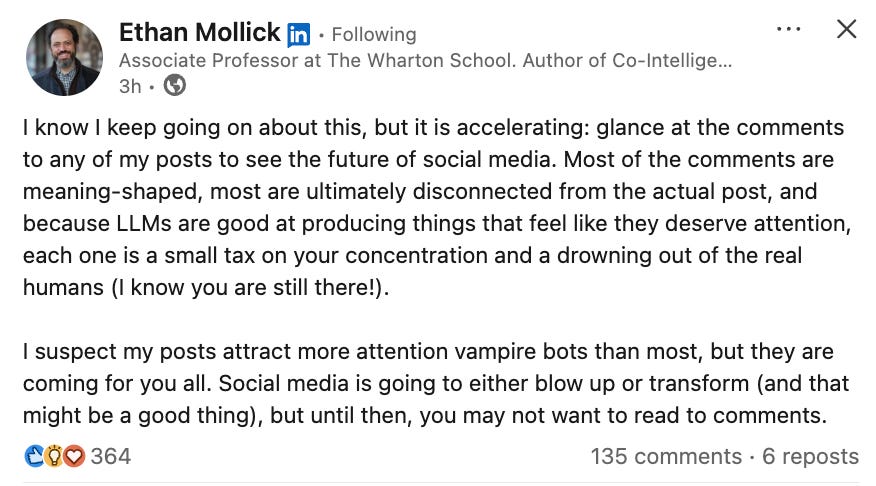
Ethan Mollick1 used a phrase recently that fits quite well this moment in 2026. He was describing the state of comments on his LinkedIn posts: how most of them are now “meaning-shaped.” Not meaningful. Meaning-shaped. Produced by language models that are very good at generating text that feels like it deserves your attention, but on closer inspection has no actual relationship to the post it’s responding to.
It’s a small observation situated from a specific platform. But I think it points at something much larger.
We are entering an era where plausible-looking outputs are essentially free to produce. Text, strategy, analysis, research. Anyone can generate a comment that looks thoughtful. Anyone can produce a memo that reads like it was written by someone who understands the problem. Anyone can assemble a report with all the structural markers of rigor: citations, frameworks, recommendations.
The uncomfortable question that follows: if producing the shape of meaning is cheap and fast, what happens to actual meaning?
I think what happens is that discernment becomes the bottleneck. Not information. Not productivity. Not even “critical thinking” in the abstract. Something more specific: the capacity to tell the difference between meaning-shaped and meaningful. Between a strategy that looks right and one that is right. Between a map that has all the expected features and one that will actually get you where you need to go.
This isn’t just a social media problem.
Organizations are adopting AI tools and producing more outputs than ever2. More reports, more analyses, more strategic plans. But the quality of their actual decision-making often hasn’t improved. Sometimes it’s gotten worse, because the volume of plausible-looking material makes it harder to identify what actually matters3. The bottleneck was never production. It was orientation: knowing what question you’re actually trying to answer, understanding the landscape well enough to evaluate the options, and having the judgment to choose well.
The same dynamic plays out in research. LLMs can help you survey a literature, draft a synthesis, even generate hypotheses. But they can’t tell you which literature matters for your question, or whether a synthesis captures what’s genuinely contested in the field, or whether a hypothesis is worth pursuing given where the frontier actually sits. That requires someone who has done the slow, unglamorous work of understanding the terrain.
In education, students can now produce essays that are structurally sophisticated and substantively hollow4 5. The old assessment model (“show me you can produce a well-formed argument”) breaks down when production is trivially easy. What remains valuable is whether someone actually understands something. Whether they can navigate a genuinely unfamiliar problem. Whether they can tell when they’re lost and figure out how to get oriented again.
The bottleneck was never production. It was orientation: knowing what question you’re actually trying to answer, understanding the landscape well enough to evaluate the options, and having the judgment to choose well.
The pattern continues to take shape6. What’s getting cheaper is almost all on the production side: generating text, assembling information, creating artifacts that have the right shape. What’s getting more valuable is almost all on the orientation side: knowing what to produce, knowing whether what you’ve produced is any good, knowing which direction to go when the landscape is complex and the maps7 are unreliable.
Speed of production is only valuable when you know what you’re producing and why. A car is a wonderful thing if you know where you’re going; if you don’t, it just gets you lost faster.
The challenge of this era isn’t building more or building faster. It’s orienting: perceiving clearly, choosing wisely, and acting with the kind of conviction that comes from having actually understood the terrain rather than just processed it.
Meaning-shaped is the symptom. Disorientation8 is the condition9. And the prescription, I think, is a kind of patient, deliberate work that our current moment doesn’t reward but desperately needs: actually figuring out where you are, where you’re trying to go, and what the landscape between here and there really looks like.
That’s the work I find myself most interested in, both intellectually and practically. More on that soon.
See also: Ethan Mollick, One Useful Thing
And paying inordinate amounts of money to offer some semblance of clarity, orientation, and confidence that whatever choice is being made with technology, it is a good one. Getting executive and team buy-in is now a prized outcome and featured in many job applications outright.
In another long-time mentoring role, whose major application process requires a project proposal and even preliminary rounds of GitHub pull requests, fellow mentors have been commiserating about the deluge of “material” that we now have to evaluate and spend effort discerning through. It is much more processing time than years past.
My Generation Is Afraid of Thinking Without AI. https://www.theatlantic.com/technology/archive/2025/09/high-school-student-ai-education/684088/
I’m a High Schooler. AI Is Demolishing My Education. The end of critical thinking in the classroom https://time.com/7318668/chatgpt-ai-education-high-school/
Yes, I’m biased, but I firmly believe we need to start shifting towards trajectory-aware framing, where we see paths and destinations more-centered parts of our evaluations.
JOPRO projects around these topics dropping soon.
Along with Present Shock and its many other contemporary terms for our present state of confusion and directionlessness.
Or as Norbert Wiener might say, “anti-homeostatic” characteristics are dominating society.
The other obvious and unpleasant side of 'meaning-shaped' interactions is that the goal is simply to gleam clout through engaging with the topic.